
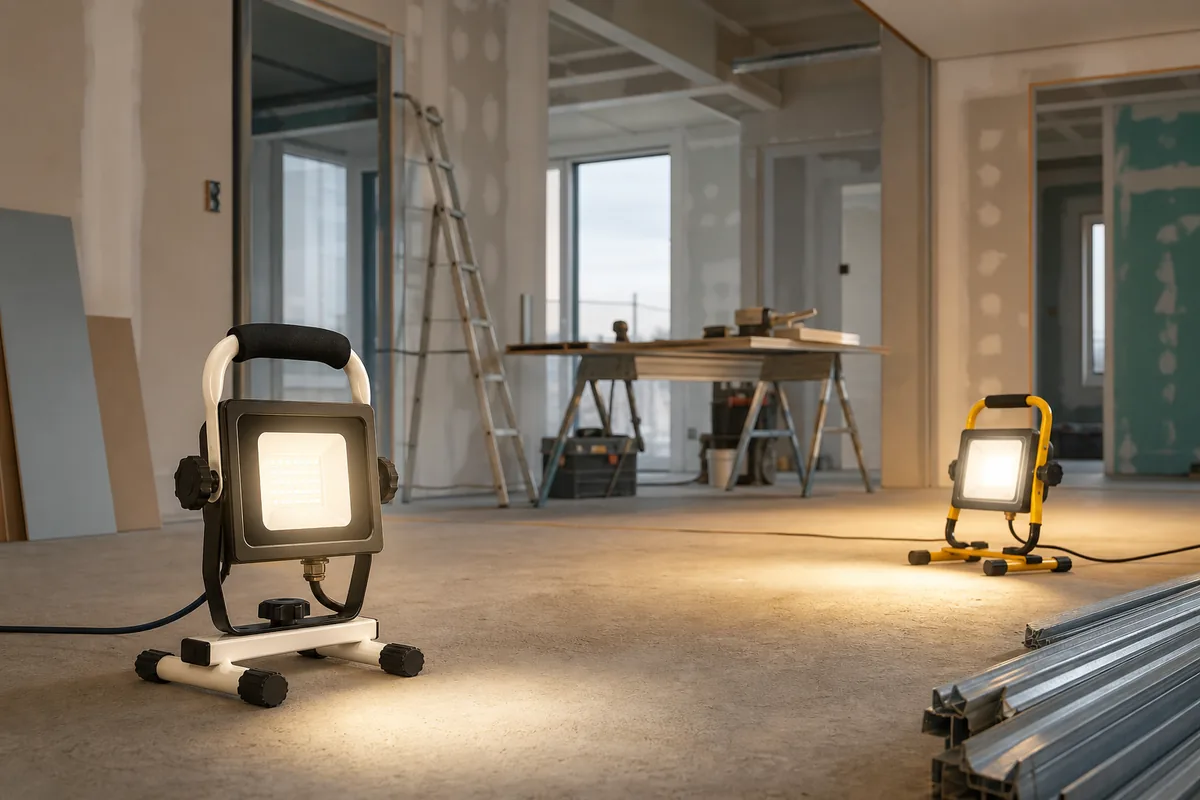
A professional work light is designed to help people work safely and efficiently. But “professional” does not mean “suitable for every environment.”
Construction sites, workshops, warehouses, railway maintenance areas, tunnels, confined spaces and industrial facilities can all require portable lighting.
But the risks in these environments are not always the same.
In many everyday applications, a robust LED work light with suitable brightness, ingress protection and mechanical durability may be exactly what the job requires.
In other environments, however, the atmosphere itself may introduce additional hazards.
That changes the lighting requirement completely.
A Worksite Can Be Dark — and Still Require More Than a Bright Light
When choosing a portable work light, buyers commonly compare specifications such as:
- Lumen output
- Beam distribution
- Runtime
- Battery type
- IP rating
- Impact resistance
- Operating temperature
- Portability
These are all important.
But before comparing any of them, there is a more fundamental question:
What kind of environment will the light actually be used in?
A general construction site and an area where flammable gases, vapours or combustible dust may be present cannot automatically use the same electrical equipment.
In hazardous locations, electrical equipment must be selected according to the classification and specific hazards of that environment.
This is why lighting selection should begin with the application — not simply with the lumen specification.
IP65 Does Not Mean Explosion-Protected
This is one of the most important distinctions for buyers to understand.
A work light may be:
IP65 rated.
That tells us about its protection against ingress of dust and water.
It does not automatically tell us that the product is suitable for use in an explosive or hazardous atmosphere.
Likewise, a work light may have:
- A strong aluminium or polymer housing
- High impact resistance
- Waterproof construction
- A protected battery compartment
- Excellent thermal management
These are valuable characteristics, but they do not by themselves make the product intrinsically safe or approved for a hazardous location.
Environmental protection and explosion protection are different requirements.
What Makes Hazardous Locations Different?
Some working environments may contain flammable gases, vapours, combustible dusts, fibres or other materials capable of creating a fire or explosion hazard.
Examples can include certain:
- Oil and gas facilities
- Chemical processing areas
- Fuel storage or handling locations
- Paint and coating operations
- Industrial plants
- Agricultural or processing environments with combustible dust
- Confined industrial spaces where a hazardous atmosphere may exist
The exact classification of an area depends on the materials present and the likelihood that a hazardous concentration will occur.
This is why simply describing a product as “industrial,” “heavy-duty” or “professional” is not enough.
The equipment must be appropriate for the specific classified location in which it will operate.
Why Can an Ordinary Electrical Device Become a Risk?
Electrical equipment can contain potential ignition sources.
Depending on its design and operating conditions, these can involve electrical sparks, switching components, electrical faults or excessive surface temperatures.
In an ordinary work environment, these characteristics may not create an explosion hazard.
In an atmosphere containing an ignitable concentration of gas, vapour or combustible dust, however, the risk assessment is very different.
This is the principle behind equipment designed and approved for hazardous locations.
The goal is not simply to protect the light from the environment.
The goal is also to prevent the electrical equipment from becoming an unacceptable ignition risk to the environment around it.
That is a fundamentally different design challenge.
What Does “Intrinsically Safe” Mean?
Intrinsic safety is a specific protection concept used for electrical equipment in hazardous locations.
In simplified terms, intrinsically safe equipment is designed so that the electrical and thermal energy available under specified conditions is limited to levels that are not capable of causing ignition in the atmosphere for which the equipment is approved.
This involves much more than placing ordinary electronics inside a stronger housing.
The electrical design, energy storage, components, temperature behaviour and possible fault conditions all become part of the safety evaluation.
This is also why terms such as intrinsically safe, explosion-protected and hazardous-location approved should not be used casually as general marketing descriptions.
They relate to specific protection concepts, classifications, standards and approvals.
Not Every Hazardous-Area Light Uses the Same Protection Method
Another important point is that “hazardous location lighting” is a broader category than “intrinsically safe lighting.”
Intrinsic safety is one protection technique.
Depending on the application and regulatory system, other explosion-protection techniques may also be used.
Therefore, buyers should not begin with the assumption:
“I need an intrinsically safe light.”
The better starting point is:
“What is the hazardous-area classification, and what equipment is approved for that location?”
From there, the appropriate lighting technology and protection concept can be selected.
Start With the Worksite, Then Choose the Light
For professional buyers, contractors and distributors, a useful lighting-selection process starts with several questions.
- Where will the light be used?Indoor workshop, outdoor construction, railway maintenance, tunnel, confined space, chemical facility or another environment?
- Is the area classified as hazardous?If flammable gases, vapours, combustible dust or fibres may be present, determine whether the work area has an official hazardous-location classification.
- What environmental conditions must the product withstand?Consider water, dust, impact, temperature, corrosion and outdoor exposure.
- How much light is actually required?Evaluate lumen output together with beam angle, working distance, uniformity and glare — not lumens alone.
- How will the product be powered?AC supply, internal rechargeable battery or professional power-tool battery platforms can each make sense in different applications.
- What certifications or approvals are required?For hazardous locations, verify the exact markings and approvals required for the intended country, zone/division, atmosphere and application.
Never assume suitability based only on appearance, IP rating or a general “industrial” description.
Professional Lighting Is About Suitability, Not Just Performance
A 10,000-lumen work light may be an excellent solution for a construction site.
A compact rechargeable inspection light may be ideal for automotive maintenance.
A power-tool battery work light may provide outstanding flexibility for contractors already using compatible battery platforms.
But none of these characteristics automatically make a product suitable for a classified hazardous location.
This is why professional lighting should not be judged by one number.
More lumens do not automatically mean better lighting.
Higher IP ratings do not automatically mean hazardous-location protection.
A stronger housing does not automatically mean explosion protection.
The right product is the one designed, tested and approved for the environment in which it will actually be used.
The FUXIN LIGHT View
At FUXIN LIGHT, we believe professional mobile lighting should begin with understanding the application.
Brightness matters.
Runtime matters.
Durability matters.
Portability matters.
But above all, suitability matters.
Before selecting a work light, understand the environment, identify the risks and confirm the technical and regulatory requirements.
Because professional lighting is not simply about putting more light into a workplace.
It is about putting the right light in the right place — safely.
Important Note
This article provides general educational information and is not a hazardous-area classification, engineering assessment or safety certification recommendation.
Requirements vary by country, industry and application. For potentially explosive or otherwise classified hazardous locations, always consult the applicable regulations, site safety documentation and qualified professionals, and use equipment specifically approved for the intended location.
FUXIN LIGHT — Mobile Lighting Solutions
Related Articles
- How To Choose A Work Light
- IP Rating Guide for Work Lights & Outdoor Lighting
- AC vs Battery Work Light
- What Is A Battery Powered Work Light?
Need Help Selecting a Work Light for Your Application?
FUXIN LIGHT provides professional mobile lighting solutions for distributors, importers and professional markets.
Contact FUXIN LIGHT