
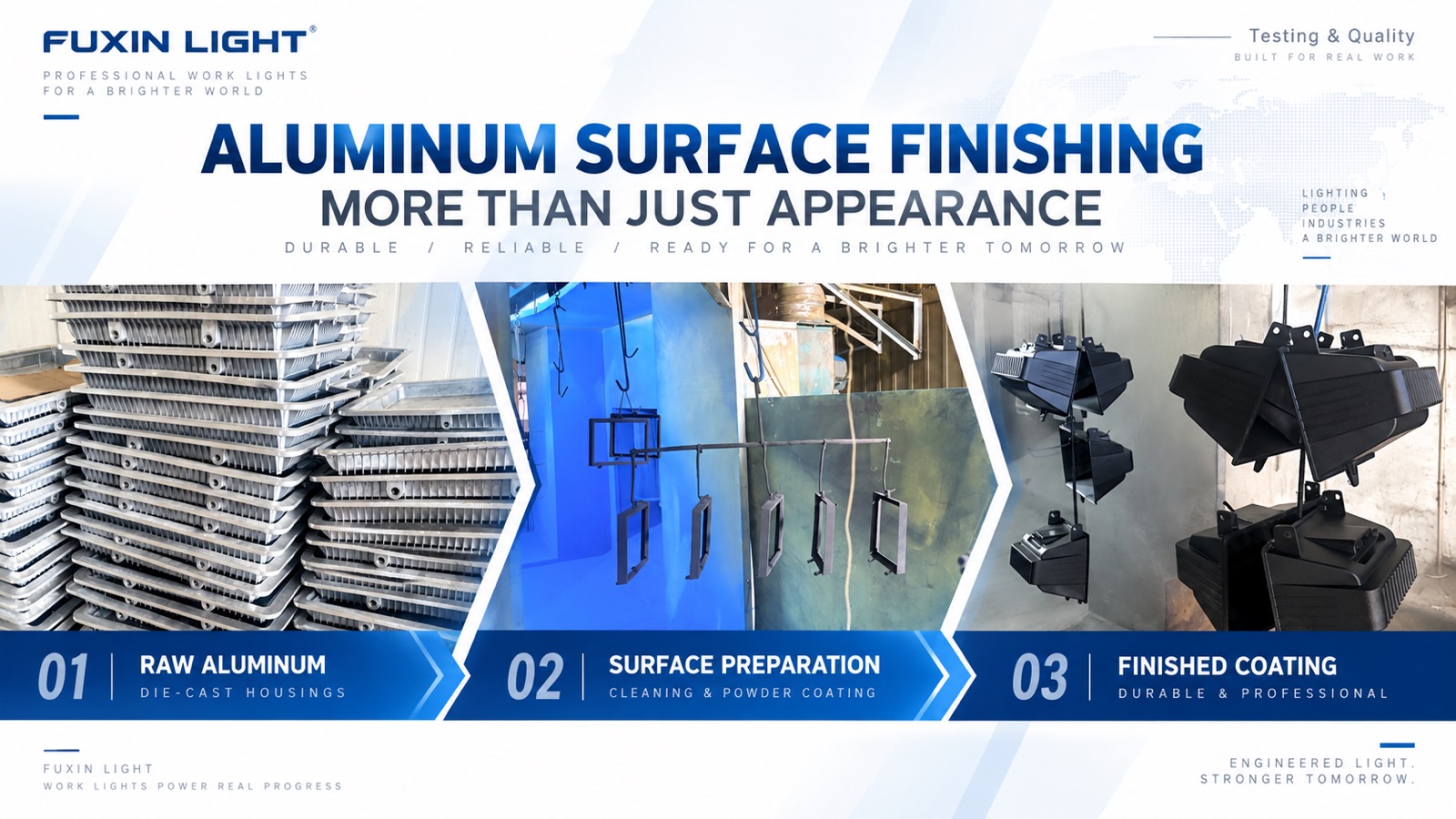
For a professional LED work light, the aluminum housing is both a structural component and part of the thermal path. Its surface finish also contributes to corrosion protection, handling durability, visual consistency and the product identity expected by distributors and OEM brands.
Evaluating the finish therefore requires more than choosing a color. Base material, cleaning, pretreatment, coating, curing, inspection, fasteners, product geometry and the intended environment all need to work as one system.
Why Aluminum Is Commonly Used in Professional Work Lights
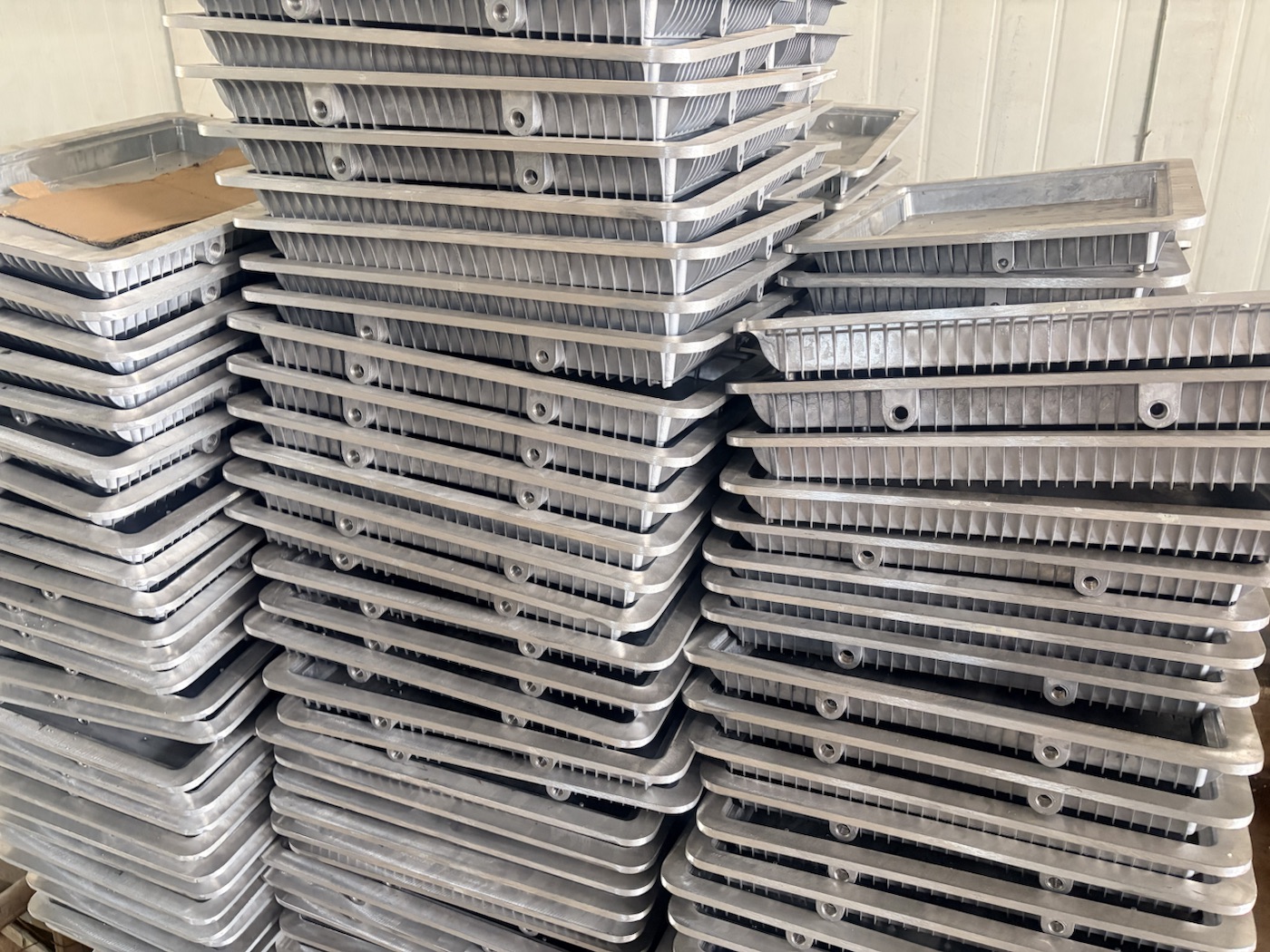
Aluminum combines relatively low weight, useful mechanical strength, formability and thermal conductivity. Die-cast housings can integrate ribs, mounting points, cable entries and sealing features into one component, while fins increase the surface area available to release heat.
The exact alloy, wall thickness and casting quality still matter. Surface finishing cannot correct major porosity, dimensional errors or an unsuitable thermal design; it is one layer within the complete product engineering process.
Surface Treatment Is Not Just Decoration
A finished housing should look consistent, but appearance is only one objective. A suitable finish helps isolate the metal surface from contaminants, improves resistance to everyday handling and supports a repeatable product appearance across production batches.
The finish must also suit assembly. Threads, grounding points, mating surfaces, seals and heat-transfer interfaces may need masking or different treatment so that the coating does not interfere with electrical or mechanical performance.
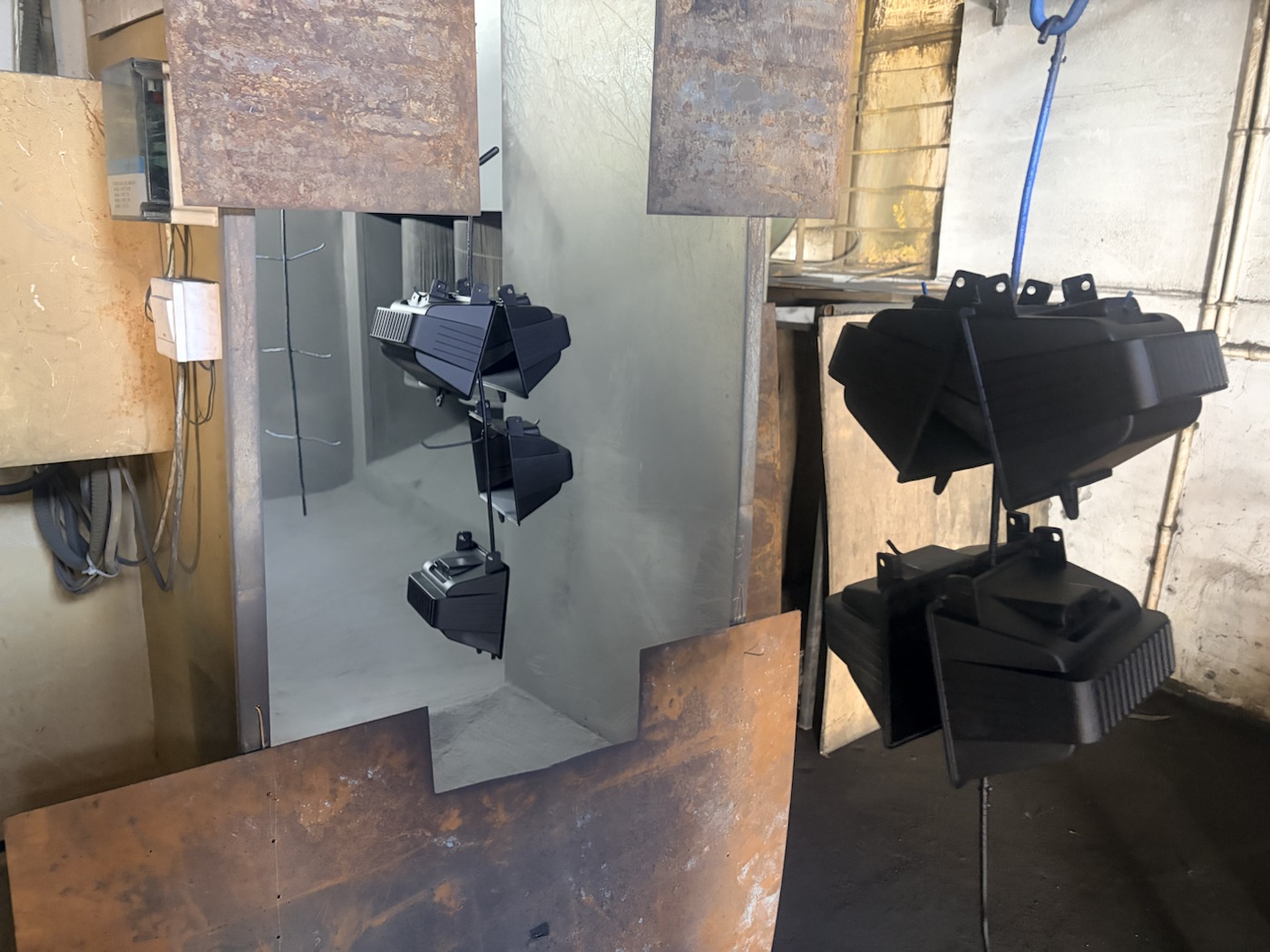
Powder Coating for Aluminum Work Light Housings
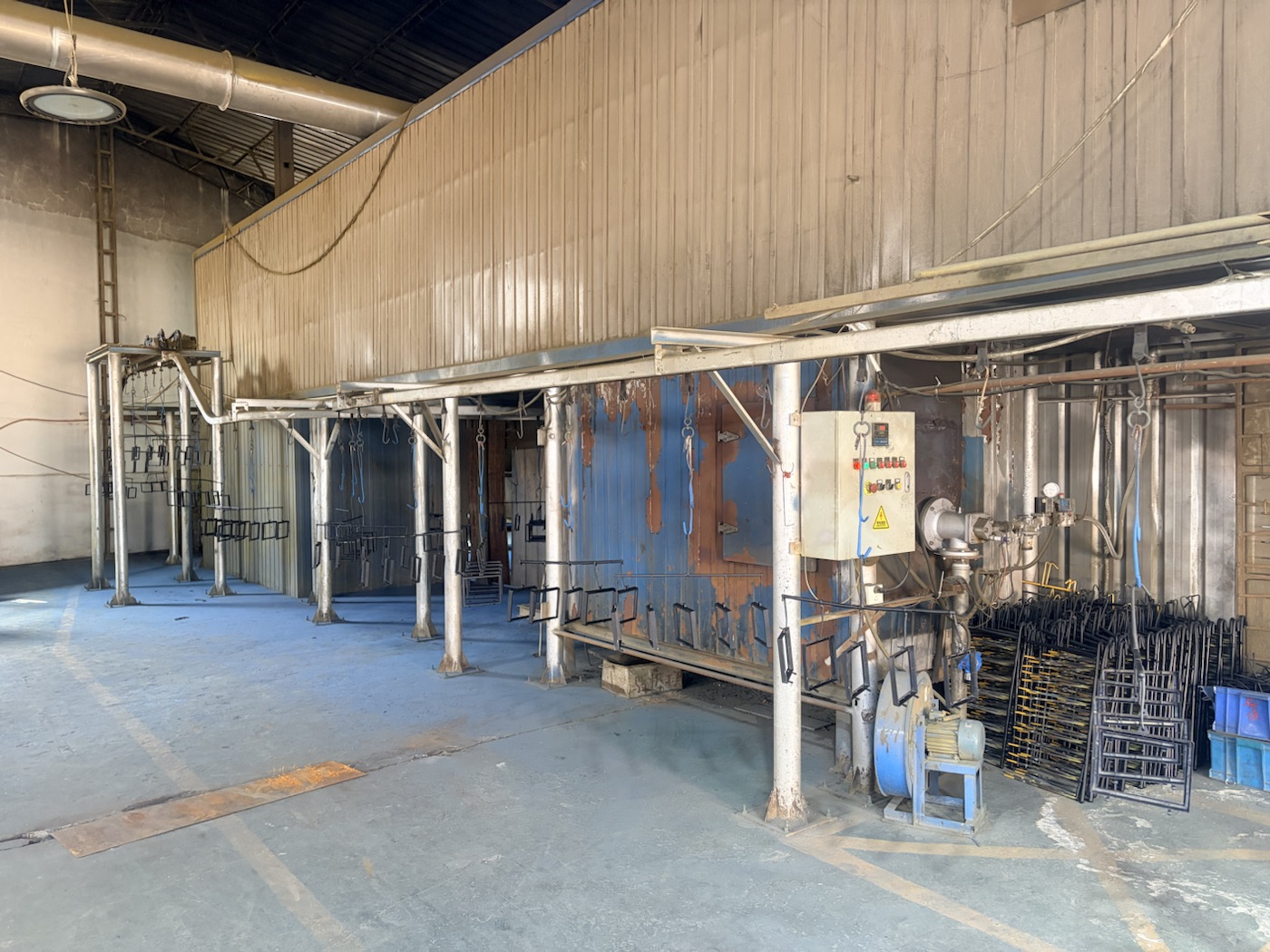
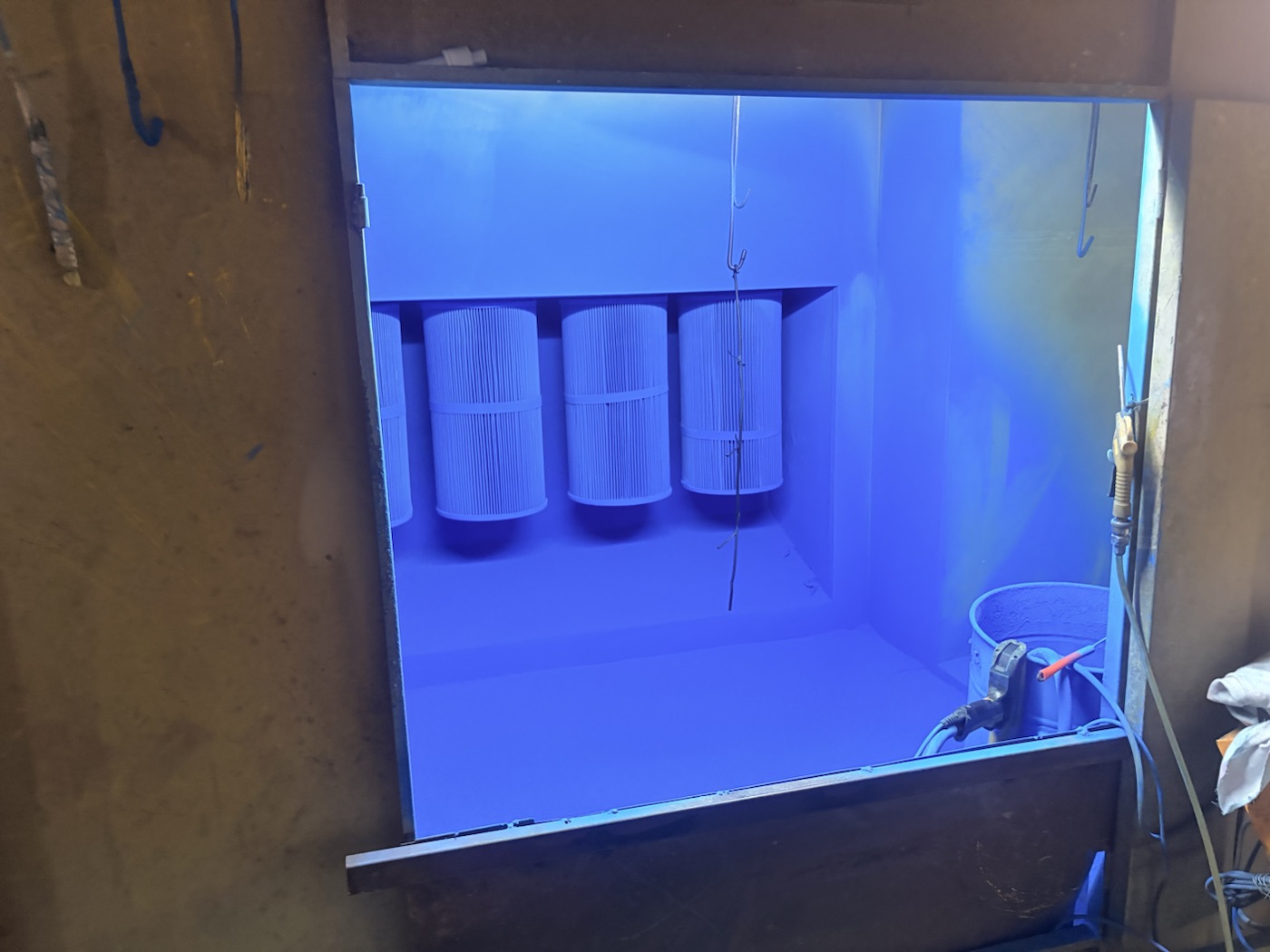
Powder coating is widely used because it can provide an even, durable finish with a broad choice of colors and textures. Electrostatic application places dry powder on a prepared metal surface, after which controlled curing forms the final coating film.
Good results depend on more than the powder itself. Stable application, part grounding, gun setup, coverage around fins and recesses, cure conditions and handling all influence the finished housing.
Surface Preparation Matters
Oil, release agents, dust and oxidation can reduce coating adhesion. Cleaning and degreasing remove contamination, while suitable pretreatment prepares the aluminum surface for the selected coating system. Drying must be complete before powder application.
The exact pretreatment method should be chosen according to alloy, coating specification, regulatory requirements and the target environment. Buyers should ask suppliers to explain the process used for the specific product rather than accept a generic statement such as “powder coated.”
Representative Surface-Finishing Process
Simplified representative process. Actual steps and controls depend on the material, coating system and product requirements.
Powder Coating vs. Liquid Painting
| Consideration | Powder Coating | Liquid Painting |
|---|---|---|
| Application | Dry powder is electrostatically applied and cured. | Liquid coating is sprayed or otherwise applied, then dried or cured. |
| Finish options | Broad range of colors, gloss levels and textures. | Broad color range and potentially specialized thin or decorative systems. |
| Complex geometry | Coverage around deep recesses and tight fins requires process control. | May offer application flexibility, but runs, solvent behavior and drying must be controlled. |
| Selection | Neither method is universally superior. The correct system depends on material, geometry, environment, volume, appearance and performance requirements. | |
What About Anodizing?
Anodizing creates a controlled oxide layer on aluminum rather than adding a separate paint film. It can provide a durable surface and a distinct metallic appearance, but suitability depends on alloy, casting condition, color expectations, component geometry and cost.
Die-cast parts may not produce the same cosmetic result as extruded or machined aluminum. For many work-light housings, powder coating provides greater flexibility for brand colors and textured finishes, while anodizing may be considered for selected parts or design objectives.
Does Surface Finishing Affect Heat Dissipation?
Surface condition and finish can influence radiative and convective behavior, but a coating color alone does not determine whether a work light runs cool. It is inaccurate to say that black automatically solves thermal performance or that bare aluminum is always better.
The complete thermal path must be evaluated: LED → PCB → thermal interface → aluminum housing or heat sink → surrounding air. LED efficiency, power level, contact area, interface material, fin geometry, housing mass, airflow, ambient temperature and mounting orientation may all have a larger effect than appearance.
Thermal validation should therefore use the assembled product under defined operating conditions, not assumptions based only on housing color.
Corrosion Resistance Depends on Environment
Aluminum does not form red rust in the same way as carbon steel, but it can still corrode. Moisture, salt, industrial contaminants, cleaning chemicals, dissimilar-metal contact and trapped water can challenge a housing and its fasteners.
Effective protection is a system: base material + pretreatment + coating + fasteners + drainage and sealing design + intended environment. A coating that works indoors may not be appropriate for coastal, marine, chemical or continuously wet conditions.
Test methods and acceptance criteria should be agreed for the actual project. A supplier should not promise a specific salt-spray duration unless the product, coating system and documented test evidence support that claim.
Don’t Forget Screws, Brackets and Contact Points
A well-coated aluminum body can still be undermined by unsuitable screws, brackets, springs or mounting hardware. Buyers should review the materials and finishes of all exposed components, especially where different metals touch.
Edges, threaded holes, grounding points and bracket contact areas also deserve attention. Masking must be deliberate: too much coating can obstruct assembly, while exposed areas can become corrosion initiation points if they are not properly designed.
Coating Thickness: More Is Not Always Better
Insufficient film build can leave weak coverage or visible substrate. Excessive thickness can soften details, interfere with threads and assembly, create appearance defects or hide rather than solve surface problems.
The appropriate range depends on the coating supplier’s technical requirements, part geometry and project specification. Consistency across critical surfaces is normally more useful than chasing the highest possible number.
How Should Surface Quality Be Evaluated?
Inspection should combine documented process control with product-level checks. Requirements should be agreed before production so that the same acceptance standard can be applied to samples and mass production.
Color, gloss, texture, coverage, contamination, pinholes, runs and handling marks.
Measured at defined locations using a suitable calibrated method.
Evaluated with an agreed method appropriate to the coating system and substrate.
Selected according to the target market, environment and project specification.
Comparison of approved samples, batch records and finished goods across the order.
Surface Finish Is Also Part of Product Design
Finish selection should start during product development, not after tooling is complete. Rib spacing, drainage, sharp edges, recessed features, hanging points and masking areas can affect how reliably a housing is cleaned, coated, cured and assembled.
Color and texture also influence how users perceive the product. A matte industrial finish may hide minor handling marks; a high-gloss finish may reveal them. Brand appearance should therefore be balanced with real production capability and the expected use environment.
OEM and ODM Surface-Finish Decisions
For OEM and ODM lighting projects, buyers can discuss housing color, gloss, texture, brackets, logo application and retail or industrial packaging as one coordinated program. Physical color chips or approved coated samples are generally more reliable than screen images or digital color references.
An approved master sample, defined viewing conditions and documented tolerance help reduce disputes when products are produced in separate batches.
Questions Buyers Should Ask
- What aluminum alloy and casting process are used for the housing?
- How are oil, release agent, dust and oxidation removed before coating?
- What pretreatment is used for this specific aluminum part?
- Which areas are masked, and why?
- How are powder application and curing conditions controlled?
- How are color, texture and gloss approved for repeat orders?
- How is coating thickness checked, and at which locations?
- What adhesion or corrosion validation is available for the requested environment?
- Are screws, brackets and exposed hardware suitable for the same environment?
- Can production samples be compared with an approved physical reference?
The FUXIN LIGHT View
For FUXIN LIGHT, a professional work light should be evaluated as a complete system. The housing material, surface preparation, finish, fasteners, thermal path, sealing design and application environment all influence long-term consistency.
Surface finishing is therefore not a cosmetic afterthought. It is an engineering and production decision that should be specified early, verified clearly and aligned with how the product will actually be used.