
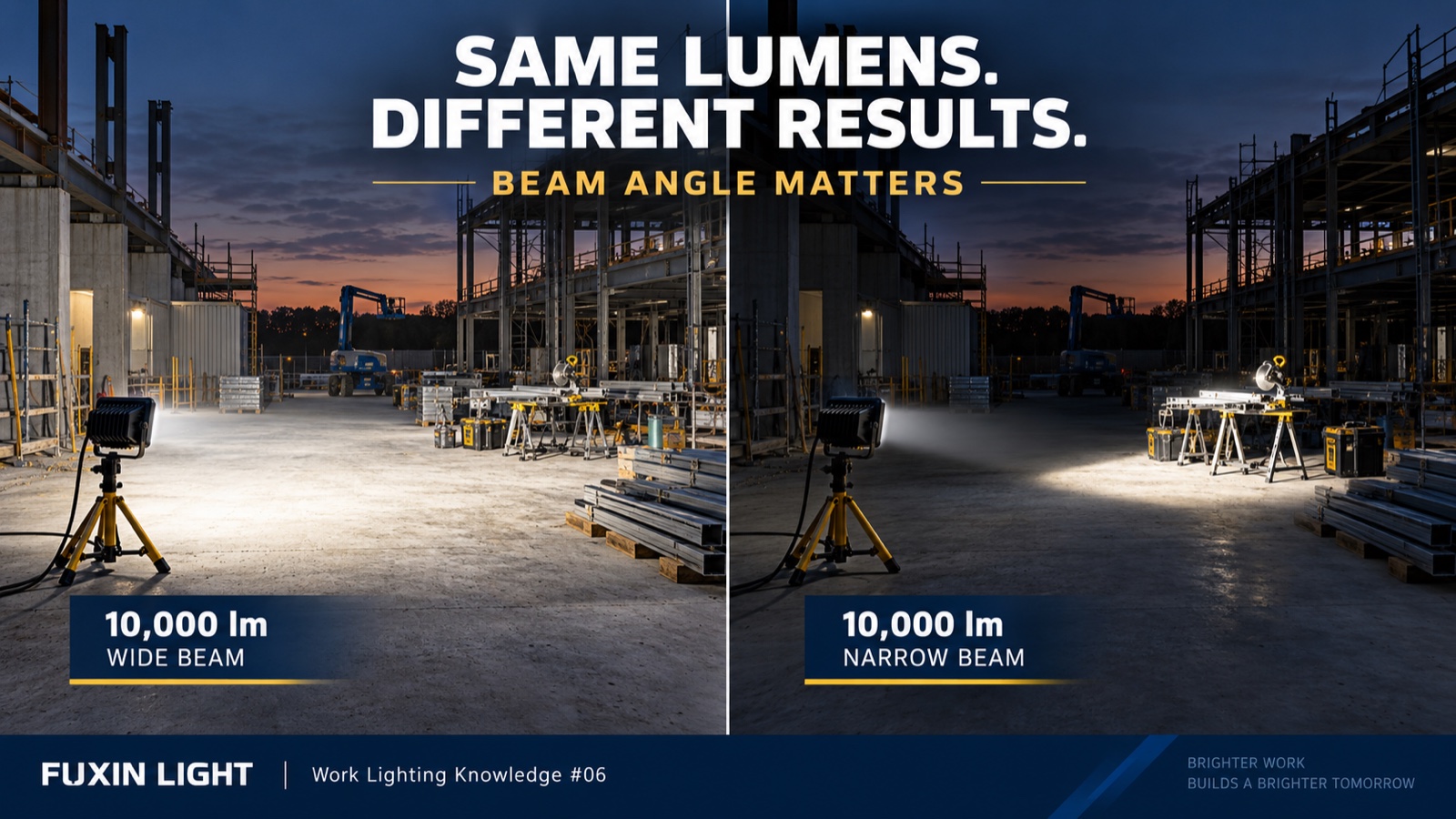
Two work lights can produce the same lumen output and still illuminate a real worksite in very different ways.
Lumens describe total visible light output. They do not explain how widely that light spreads, how strongly it is concentrated, or how much useful illumination reaches the task.
For professional buyers, beam angle and light distribution are therefore essential parts of evaluating a work light—alongside output, working distance, mounting position and application.
What Does Work Light Beam Angle Mean?
Beam angle describes the angular spread of light leaving a luminaire. A wider beam spreads light over a larger area. A narrower or more controlled beam directs more of the available light toward a smaller area.
This does not mean that one beam is automatically superior. A wide beam can be useful for general work-area illumination, while a controlled beam can be useful where the task is smaller, farther away or requires greater emphasis.
Beam angle is only one part of the optical system. Reflectors, lenses, LED placement, diffusion and the shape of the luminaire all influence the final light distribution.
Wide Beam vs. Narrow or Controlled Beam
WIDE BEAM
Larger illuminated area
Broader coverage
Lower concentration
Suitable for general work-area illumination
NARROW / CONTROLLED BEAM
Smaller illuminated area
Higher concentration
Greater task emphasis
Useful where more directed illumination is required
Neither is automatically better. The correct choice depends on the application.
Why the Same Lumens Can Produce Different Results
Imagine two professional work lights, both rated at 10,000 lumens. One distributes its output broadly across a construction area. The other concentrates the same total output onto a smaller task zone.
The wide-beam light may provide better coverage for several workers, floor-level tasks or a larger temporary work area. The controlled-beam light may create higher illuminance on a particular surface and stronger visual emphasis at a longer working distance.
Both products can legitimately have the same lumen rating. Their usefulness depends on where the light is needed.
This builds on the distinction explained in Lumens vs. Lux: What Really Matters for Work Lighting?: total output and light reaching a surface are related, but they are not the same measurement.
Working Distance Changes the Illuminated Area
The same light also behaves differently as its distance from the task changes. When the light moves farther away, the illuminated area generally becomes larger while illuminance at the working surface generally decreases.
Higher concentration
Lower surface illuminance
Lower surface illuminance again
Conceptual illustration only. It is not product-specific photometric test data.
Actual performance depends on the optical design, mounting angle, surface orientation and surrounding environment. This is why buyers should avoid comparing lux figures unless the measurement distance and position are clearly stated.
Coverage, Concentration and the Real Task
A large, open worksite may benefit from broad coverage that helps workers see surrounding obstacles, tools and movement routes. Inspection, maintenance or distant target work may benefit from a more directed distribution.
The correct choice should start with practical questions:
- How large is the working area?General area lighting and small task lighting require different distributions.
- How far is the light from the task?Mounting height and working distance change coverage and illuminance.
- Does the user need surrounding visibility?Broad illumination may support movement and awareness around the task.
- Does the task need emphasis?Controlled light can place more useful illumination on a defined area.
- Can the light be repositioned?Adjustable heads, stands, hooks and magnetic mounting can change where useful light goes.
Mechanical Adjustability Also Controls Useful Light
Optics are not the only way to control distribution. Tilting heads, rotating heads, twin-head designs, tripod mounting and folding structures allow users to aim and position light according to the work.
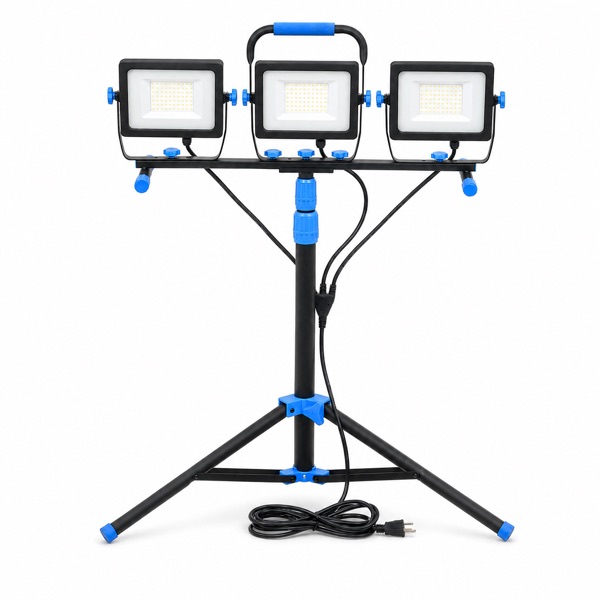
Position the light, not just the product
A tripod work light with independently adjustable heads can distribute light across a broad work zone or direct individual heads toward separate tasks. Folding and rotating work lights provide similar flexibility at closer working distances.
Explore rechargeable work lights, power tool battery work lights and the wider mobile lighting range.
A Strong Hotspot Is Not the Same as Controlled Lighting
A narrow or controlled beam is not inherently a problem. The issue is uncontrolled contrast: an extremely bright centre surrounded by much darker areas can make it harder to see the wider task comfortably.
Wide / Reasonably Uniform
Useful transition across the working area
Strong Centre Hotspot
Higher contrast with darker surroundings
This comparison illustrates distribution contrast. It does not imply that all narrow beams are poor.
Uniformity, visual comfort and glare deserve separate attention. They will be explored in a future article: Work Lighting Knowledge #07 — Why Uniformity Matters More Than Maximum Brightness.
How Professional Buyers Should Compare Beam Performance
A product page that lists only wattage and lumens cannot fully describe real work-light performance. Where available, buyers should also review beam angle, lux at stated distances, intensity distribution, mounting options, adjustment range and application photographs.
Photometric files or test reports can provide more detail for project-based products, but even without formal photometric data, suppliers should clearly communicate whether the product is intended for broad area lighting, focused task lighting or an adjustable combination of both.
For the relationship between electrical input and light output, see Watts vs. Lumens: Why More Power Doesn't Always Mean More Light. For environmental suitability, read Why an Ordinary Work Light Is Not Suitable for Every Worksite.
The FUXIN LIGHT View
Professional work lighting is not simply about producing the largest lumen number. It is about putting useful light where people need to see.
Lumens describe total output. Beam angle and distribution describe where that output goes. Working distance and mounting influence the illuminated area and surface illuminance. The application determines whether the result is useful.
That is why two work lights with the same lumen output can create completely different working environments—and why the correct beam should be selected for the task, not judged by one specification alone.
Key Takeaway
Work Lighting Knowledge Series
- 01 · Watts vs. Lumens
- 02 · Lumens vs. Lux
- 03 · Choosing the Right CCT
- 04 · IP Ratings Explained
- 05 · Why an Ordinary Work Light Is Not Suitable for Every Worksite
- 06 · Beam Angle Matters
- 07 · Why Uniformity Matters More Than Maximum Brightness
- 08 · Glare in High-Output Work Lights
Related Work Lighting Knowledge
Need help selecting the right work light for your application?
FUXIN LIGHT provides professional mobile lighting solutions for distributors, importers and professional markets.