
When comparing LED work lights, wattage is often one of the first specifications buyers look at. But watts tell you how much electrical power a light consumes — not how much light it actually produces.
A 100W work light is not automatically brighter than every 80W work light.
And a higher-wattage product is not automatically the better professional lighting solution.
To compare work lights properly, buyers need to understand the difference between watts, lumens and luminous efficacy.
Watts Measure Power Consumption
A watt (W) is a unit of electrical power.
For a work light, wattage tells us approximately how much electrical power the product uses while operating.
For example:
- Work Light A: 50W
- Work Light B: 80W
- Work Light C: 100W
This tells us something about their power consumption.
It does not, by itself, tell us how much visible light reaches the working environment.
This distinction has become increasingly important with LED technology.
Older lighting technologies often encouraged buyers to associate wattage directly with brightness because products within the same technology tended to follow relatively predictable relationships between power and light output.
With modern LEDs, that assumption becomes much less reliable.
Lumens Measure Light Output
Lumens (lm) measure luminous flux — the total quantity of visible light emitted by a light source.
If the question is: “Which work light produces more light?”
Lumens are generally more useful than watts.
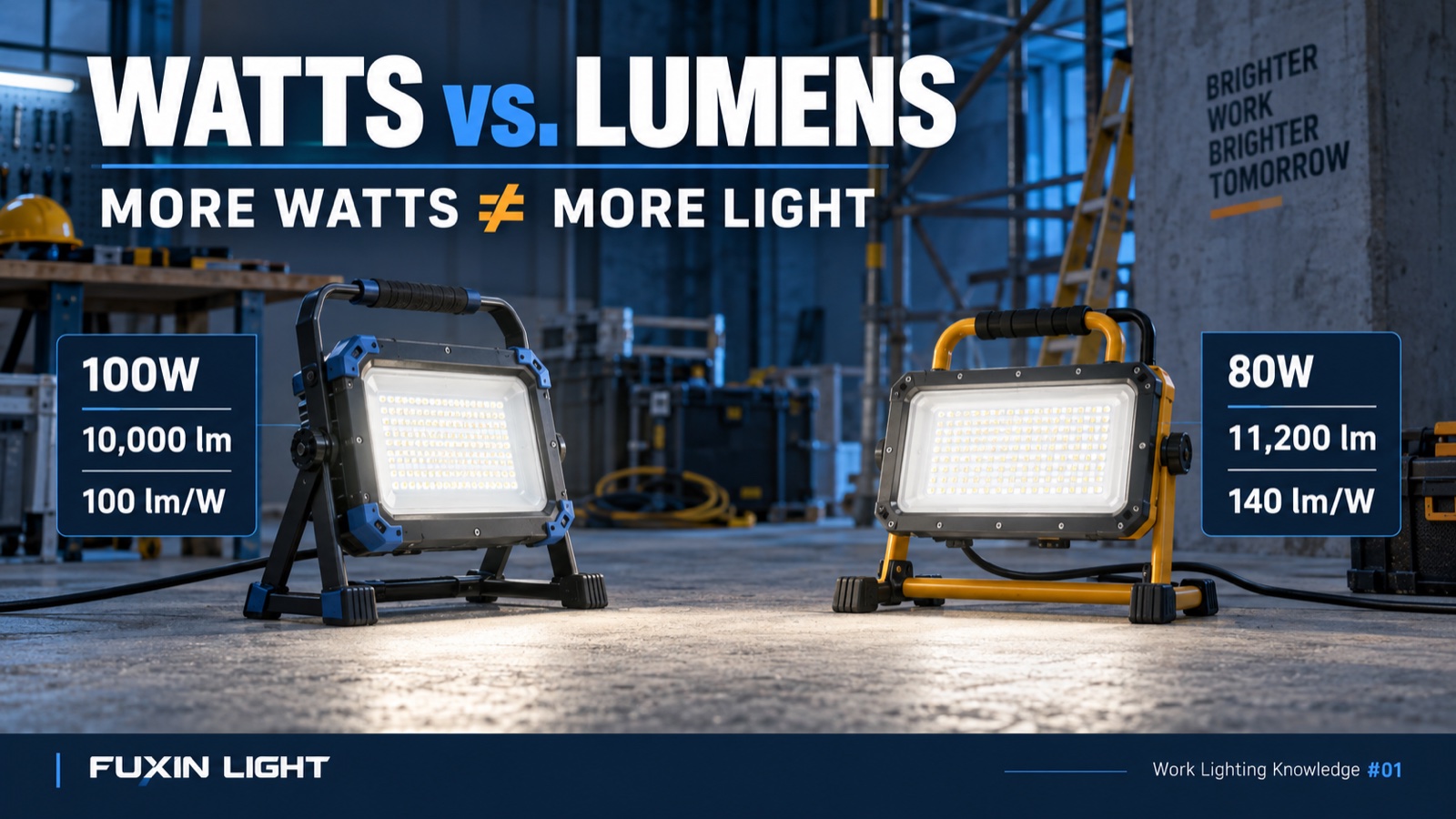
Consider two hypothetical products:
Work Light A
100W10,000 lm100 lm/WWork Light B
80W11,200 lm140 lm/WLumens ÷ Watts = lm/W
Educational example only. These figures do not represent specific FUXIN LIGHT product specifications.
Despite consuming 20W less power, Work Light B produces 1,200 more lumens.
This illustrates a simple principle: More watts do not necessarily mean more light.
Then What Is lm/W?
This brings us to another useful specification: Luminous efficacy — lumens per watt (lm/W).
It describes how effectively electrical power is converted into visible light.
The basic calculation is:
Lumens ÷ Watts = lm/W
For example:
- 10,000 lm ÷ 100W = 100 lm/W
- 12,000 lm ÷ 80W = 150 lm/W
All else being equal, a higher lm/W value means the lighting system can produce more visible light from the same amount of electrical power.
For commercial and professional lighting, this can contribute to lower energy consumption and improved system efficiency.
But there is another important point.
Higher lm/W does not automatically mean a better work light either.
Efficiency Is Only Part of the Story
This is where work-light comparison becomes more interesting.
Imagine two lights both producing 10,000 lumens.
One distributes the light evenly across a large working area.
The other concentrates much of its output into the centre, producing a very bright hotspot while leaving surrounding areas relatively dark.
Wide & Uniform Distribution
Balanced usable illumination across the work area
Strong Hotspot + Dark Edges
High centre intensity with weaker surrounding coverage
On a specification sheet, both say: 10,000 lm.
On the jobsite, they may perform very differently.
That is because professional work lighting depends on more than total lumen output.
Buyers should also consider:
- Beam angle
- Light distribution
- Lux at the working surface
- Uniformity
- Glare
- Color temperature
- Color rendering
- Thermal management
- Continuous output
- Working distance
- Installation height
This is why neither watts nor lumens should be evaluated in isolation.
Lumens vs. Lux: Another Important Difference
Lumens tell us how much light the fixture produces.
Lux tells us how much light reaches a particular surface.
1 lux = 1 lumen per square metre.
For professional users, this distinction matters.
A work light may have an impressive lumen specification, but the real question on site is often: How much useful light reaches the area where people are actually working?
Beam distribution, distance and mounting position can dramatically change that result.
This is why two work lights with similar lumen output may create very different illumination on the same jobsite.
We will explore this topic separately in our Lumens vs. Lux guide.
Don't Forget Thermal Management
LED efficiency is also closely connected to temperature.
High-output LEDs generate heat, and that heat needs to be managed properly.
A work light may produce impressive output immediately after being switched on, but professional users often operate lighting for hours at a time.
A well-designed product therefore needs effective thermal management to help maintain stable performance and protect components.
This is especially important for compact, high-output work lights where significant power is concentrated into a relatively small housing.
For professional lighting, the question should not only be: “How bright is it when I switch it on?”
It should also be: “How does it perform after several hours of operation?”
What About Rechargeable Work Lights?
The watts-versus-lumens discussion becomes even more important with battery-powered lighting.
For a rechargeable work light, higher power consumption can affect runtime.
Imagine two products producing similar useful illumination.
If one requires substantially more electrical power to achieve it, the difference may influence:
- Battery size
- Runtime
- Product weight
- Charging requirements
- Heat generation
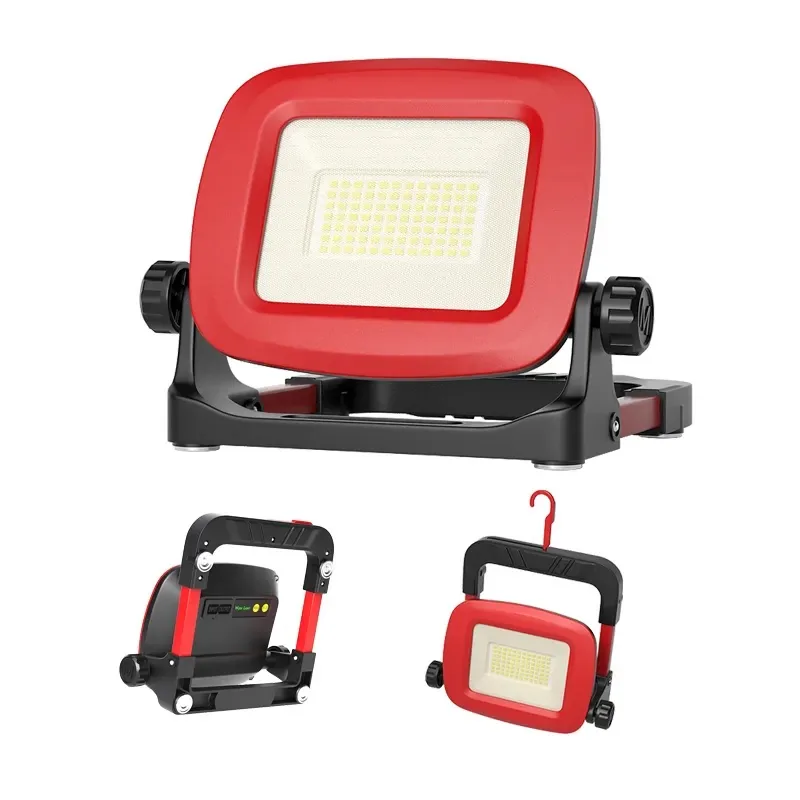
This is why professional portable lighting requires balancing all three factors rather than maximizing lumen output alone.
A 10,000-lumen light that runs for a short period may not be the best solution for every application.
Neither is a very long-running light useful if it cannot provide enough illumination for the task.
The right balance depends on the job.
How Should Buyers Compare Work Lights?
When evaluating professional work lights, we recommend looking beyond the wattage printed on the specification sheet.
- Lumen outputHow much total visible light does the product produce?
- Luminous efficacyHow efficiently does it convert electrical power into visible light?
- Light distributionWhere does that light actually go?
- Lux at relevant distancesHow much illumination reaches the working surface?
- Uniformity and glareIs the working area comfortably and consistently illuminated?
- Continuous performanceCan the product maintain useful output during extended operation?
- Power source and runtimeFor rechargeable models, how does output affect battery life?
- ApplicationConstruction, inspection, automotive repair, outdoor maintenance and large-area lighting do not necessarily require the same solution.
Don't Buy the Biggest Number
Lighting specifications are useful.
But specifications only become meaningful when we understand what they measure.
Watts tell us about power.
Lumens tell us about total light output.
lm/W tells us about efficiency.
Lux tells us how much light reaches a surface.
And ultimately: The application tells us whether the lighting solution is actually suitable.
For professional work lighting, the goal should not be to select the product with the largest wattage printed on the box.
Nor should it simply be the product claiming the highest lumen number.
The goal is to deliver useful, efficient and reliable illumination where the work is actually being done.
The FUXIN LIGHT View
At FUXIN LIGHT, we believe professional mobile lighting should be evaluated by real-world performance rather than a single specification.
Power matters.
Light output matters.
Efficiency matters.
But so do distribution, runtime, durability, thermal management and the working environment.
That's why a better question than: “How many watts is it?”
is: “How effectively does it light the job?”
Because in professional lighting: More power doesn't always mean more light — and more light doesn't automatically mean better lighting.
FUXIN LIGHT — Professional Mobile Lighting Solutions
Work Lighting Knowledge Series
- 01 · Watts vs. Lumens
- 02 · Lumens vs. Lux
- 03 · Choosing the Right CCT
- 04 · IP Ratings Explained
- 05 · Why an Ordinary Work Light Is Not Suitable for Every Worksite
- 06 · Beam Angle Matters
Related Articles
- Lumens vs. Lux: What Really Matters for Work Lighting?
- Why an Ordinary Work Light Is Not Suitable for Every Worksite
- IP Rating Guide for Lighting Products
- How To Choose A Work Light
Looking for the right work light for your application?
FUXIN LIGHT provides professional mobile lighting solutions for distributors, importers and professional markets.